


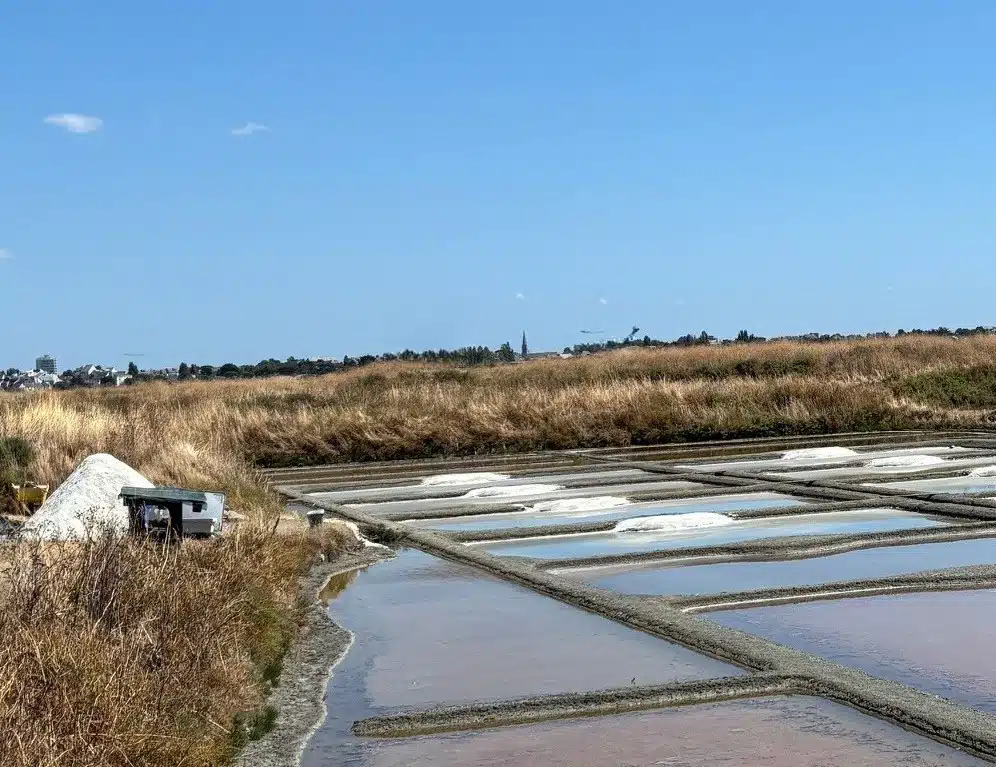
French fleur de sel is a treasure born on the salt marshes, shaped by wind and sun.
Since the Middle Ages, paludiers have harvested it by hand with the lousse, a wooden tool passed down from generation to generation. Never washed, never ground, it remains rich in minerals. Every summer, the harvest takes place at dusk. National output remains confidential: just a few hundred tonnes a year. In Guérande, it ranges from 200 to 400 tonnes depending on the weather. Yet each production region gives it a unique character.
The different producing regions.
In Brittany, Guérande fleur de sel offers a subtle, slightly sweet flavour. Its fine, crunchy crystals have been protected by a PGI since 2012. In Camargue, Camargue fleur de sel takes on a pink hue, coming from clay and micro-algae. It also holds a PGI, since 2014. Its pronounced taste suits grilled meats and fish. On the island of Ré, delicate white crystals deliver a balanced flavour, perfect on seafood. In Noirmoutier, the salt turns soft and melting, ideal with cheeses and salted butter. Finally, in Morbihan and Finistère, Breton fleur de sel shows an iodine taste and greyish crystals, dear to Breton tradition.
Use and storage.
Thus, every use finds its ideal flower. For desserts, favour Guérande or Noirmoutier. For meats, choose Camargue instead. Ré island salt excels on salads. A single pinch is enough to transform a simple dish. For storage, keep it in a glass or ceramic jar. Avoid plastic, which alters the flavour. Protected from humidity, French fleur de sel keeps indefinitely.
These five terroirs cover most of the national output.
They also interest distributors : French fleur de sel brings a premium image, origin labels and steady volumes all year round. importers, contact us to discover our ranges of fleur de sel and our product page.
